The digital world has gifted us a new arena of competition, recreation, and commerce – online gaming. From the strategic brilliance of a fantasy sports team selection to the lightning-fast reflexes of an e-sports champion, this industry has become a juggernaut, commanding billions in revenue and capturing the imagination of millions. Yet, this meteoric rise has also brought with it a Pandora’s Box of legal and social challenges. For years, the industry has operated in a murky legal twilight, but now, the Central Government, by enacting the much-debated Promotion and Regulation of Online Gaming Act, 2025 (hereinafter, the ‘2025 Act’), has seemingly moved to call the shots.
BACKDROP
Despite its unstructured regulatory legal framework, the Indian online gaming industry has the second-largest gaming community with 442 million players, is expected to grow by 20% by FY2025 to reach INR 231 billion, and has raised USD 2.8 billion from both domestic and foreign investors over the last five years. Because the stakes are so high and the gaming business is developing so quickly, the unrestrained growth of online gaming platforms has resulted in illegal actions that threaten national security, public order, and national integrity, making these issues much more pressing. Therefore, the Indian government has taken the step to introduce the bill and it surely deserves accolades. By officially recognizing e-Sports and online social games and outlawing and criminalizing online money gaming services in accordance with constitutional provisions like Article 21 (Right to Life and Personal Liberty) and Article 47 (Duty of the State to raise the level of nutrition and the standard of living and to improve public health), the Online Gaming Act aims to create a comprehensive legal framework for India’s online gaming industry.
The Act thus reflects a two-pronged legislative intent: (i) promotion and recognition of skill-based, non-monetary gaming as legitimate recreation and sport, and (ii) prohibition and penalization of gambling-oriented online money games. However, the practical difficulty lies in balancing these objectives without trampling over constitutional guarantees or established judicial interpretations.
PRE-EXISTING LEGAL REGIME ON GAMING
Before the enactment of the Online Gaming Act, India’s regulatory landscape for gaming was fragmented and antiquated. Gambling falls under Entries 34 and 62 of the State List, leaving states to frame their own laws, which led to significant inconsistencies and ambiguities. The only central statute, the Public Gambling Act, 1867 (PGA), dealt primarily with physical gaming houses and was ill-suited for the realities of digital platforms. While the PGA carved out an exception for games of “mere skill,” the advent of online gaming revealed glaring gaps in its applicability. Judicial interpretations complicated the picture further, as courts across jurisdictions delivered differing rulings on whether games like rummy, poker, or fantasy sports qualified as games of skill.
In the absence of a unified central framework, states like Tamil Nadu, Karnataka, and Telangana attempted to plug this vacuum through piecemeal amendments, many of which were subsequently struck down for overreach. The judiciary’s consistent reiteration, that skill-based games do not constitute gambling, was thus repeatedly pitted against sweeping legislative bans. The 2025 Act now attempts to centralize this fractured regime but, in doing so, may have inadvertently overridden established constitutional and judicial safeguards.
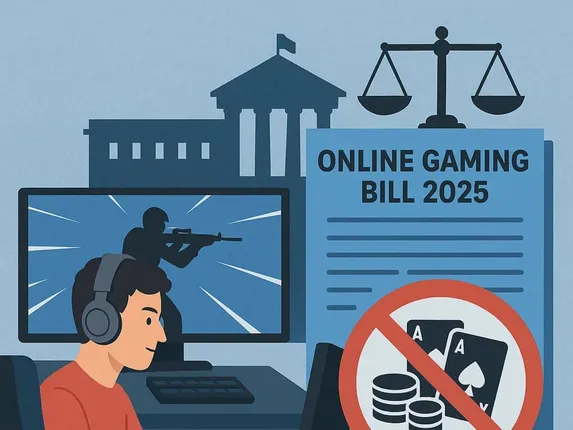
STATUTORY FRAMEWORK AND GAME CATEGORIZATION UNDER THE ACT
Section 2(1)(f) of the Promotion and Regulation of Online Gaming Act, 2025 defines an “online game” as any game conducted on an electronic or digital device, operated through software, and facilitated by the internet or other electronic communication technologies.[1] The Act further divides online games into three distinct categories:
(a) E-sports: Defined under Section 2(1)(c), these are games played as part of multisport events recognized under the National Sports Governance Act, 2025. They are skill-centric activities and expressly exclude any monetary stakes.[2]
(b) Online social games: As per Section 2(1)(i), these are non-monetary games intended for purposes of recreation, education, or skill development.[3]
(c) Online money games: Section 2(1)(h) covers games involving stakes, entry fees, or deposits made with the expectation of monetary gains. Such games may include elements of skill and chance but are explicitly excluded from the definition of e-sports.[4]
The Act imposes a categorical prohibition on online money games. It bans advertisements promoting such formats, restricts financial institutions from processing associated transactions, and creates a Central Authority under Section 8 empowered to classify games, monitor compliance, and determine whether a particular format falls within the ambit of an “online money game.”[5]
This tripartite categorization, while seemingly comprehensive, is likely to give rise to interpretative disputes, especially regarding hybrid games that combine elements of skill and chance, such as fantasy sports or poker.
FRAMEWORK UNDER THE ONLINE GAMING ACT, 2025
The Online Gaming Act, 2025 introduces a stringent penal regime to deter unlawful online money gaming. It criminalises the offering, facilitation, and advertisement of such games, while also targeting financial transactions that fuel the ecosystem. Importantly, all offences are cognizable and non-bailable under the Bharatiya Nagarik Suraksha Sanhita, 2023 (BNSS), empowering enforcement authorities to make arrests without a warrant. The key penalty provisions can be outlined as follows:
(a) Penalty for Offering Online Money Games
Any person offering an online money gaming service in contravention of Section 5[6] of the Act is liable under Section 9(1)[7] to imprisonment for up to three years, or a fine up to ₹1 crore, or both.
(b) Penalty for Advertisements
Under Section 6,[8] individuals who make or cause advertisements in any medium to promote online money games are punishable with imprisonment up to two years, or a fine up to ₹50 lakh, or both.
(c) Penalty for Financial Transactions
Any person engaging in or authorising financial transactions in violation of Section 7 of the Act faces imprisonment of up to three years, or a fine up to ₹1 crore, or both.[9]
(d) Enhanced Penalties for Repeat Offences
As per Section 9(4), repeat offenders face significantly stricter consequences.[10] For the second and every subsequent conviction, imprisonment shall not be less than three years but may extend up to five years, along with a fine not less than ₹1 crore, which may extend to ₹2 crore.
While these provisions showcase the government’s determination to curb online money gaming, they also risk being misapplied to legitimate gaming operators, influencers, and payment intermediaries due to the vague and expansive definitions adopted under the Act.
A CENTRAL WATCHDOG FOR ONLINE GAMING
One of the most significant features of the Online Gaming Act, 2025 is the establishment of a Central Authority to oversee and regulate the online gaming industry. Earlier, in 2023, the Ministry of Electronics and Information Technology had introduced provisions under the Information Technology (Intermediary Guidelines and Digital Media Ethics Code) Rules, 2021 for the appointment of self-regulatory bodies (“SRBs”) to govern online games. However, no SRBs were actually constituted, leaving a regulatory vacuum.
The new law empowers the Central Government to constitute the Online Gaming Authority, or designate an existing body, to discharge crucial functions. These include registering and classifying online games, issuing operational and compliance guidelines, determining whether a game qualifies as an “online money game,” managing complaints, and ensuring adherence to industry standards. The move to establish a central authority represents a paradigm shift from fragmented state-level controls to a unified national framework.
However, questions of federal competence, given that gambling traditionally falls under the State List, may soon invite constitutional challenges under Article 246.
Critical Note: By empowering the authority to take down gaming platforms, enter digital or physical spaces without prior judicial sanction, and bypass security protections to seize data, the Act risks eroding individual privacy and procedural safeguards, leaving room for intrusive surveillance unchecked by due process.
SKILL VS. CHANCE: A COLLAPSED DIVIDE IN 2025 ACT
Indian courts have repeatedly reinforced the line between games of skill and games of chance. In All India Gaming Federation v. State of Karnataka,[11] the Court struck down provisions of the Karnataka Police (Amendment) Act, 2021 that banned online games played for stakes, emphasizing that games demanding judgment, strategy, and knowledge fall within the ambit of skill rather than chance. Similarly, in DM Gaming (P) Ltd. v. State of UP,[12] the Allahabad High Court ruled that Poker and Rummy are predominantly games of skill, not gambling.
Yet, the Act blurs this well-established distinction by sweeping all stake-based games into the definition of ‘online money games.’ By imposing a blanket ban without accounting for the skill element, it erases the judicially recognized divide and enforces an over broad prohibition.
This not only contravenes precedent but also undermines the principle of proportionality, a cornerstone of modern constitutional jurisprudence.
GAMING AS LIVELIHOOD: A CONSTITUTIONAL BLIND SPOT
The sweeping ban on online money games, even those rooted in skill, effectively deprives thousands of professional players of their constitutionally protected right to livelihood under Article 19(1)(g).[13] By erasing the crucial line between games of skill and chance, the Act extinguishes a legitimate profession and arbitrarily undermines settled jurisprudence. This overbroad prohibition not only disregards judicial recognition of skill-based gaming but also infringes upon Article 21,[14] which safeguards the right to life and the freedom to pursue one’s occupation.
Moreover, the Act fails to appreciate that the online gaming ecosystem, spanning developers, content creators, e-sports professionals, and investors, represents a significant employment generator. A legislative approach that criminalizes participation rather than curbs misuse may have chilling effects on India’s burgeoning digital economy.
A PROPORTIONATE ALTERNATIVE
While the blanket ban on online money games is ostensibly intended to tackle addiction and financial harm, it comes at the cost of dismantling a growing digital economy. A more proportionate approach would have been a licensing and regulatory framework that differentiates between games of skill and chance, enabling legitimate platforms to function under strict compliance norms. The Act, already facing constitutional scrutiny, bypasses less restrictive alternatives such as licensing requirements. By resorting to an indiscriminate prohibition, it risks being struck down as disproportionate, excessive, and not the least restrictive means of achieving its stated objectives.
Global precedents, from the UK Gambling Commission to Singapore’s Online Gaming Regulations, show that responsible regulation, not prohibition, offers a more sustainable model.
THE ROAD AHEAD
The Promotion and Regulation of Online Gaming Act, 2025 is a landmark attempt to bring clarity and structure to a long-ignored sector. While its intent to safeguard public interest and curb social harms cannot be denied, the sweeping ban on stake-based online games risks overshooting its objectives. By collapsing the judicially recognized distinction between skill and chance, undermining livelihood rights, and empowering intrusive enforcement mechanisms, the Act raises serious constitutional and policy concerns. A more nuanced framework anchored in regulation, licensing, and proportionate safeguards would better balance innovation with accountability, ensuring that India’s digital gaming industry evolves responsibly without stifling legitimate enterprise or individual freedoms.
India now stands at a crossroads, between overregulation that stifles innovation and responsible governance that nurtures it. A more nuanced framework anchored in licensing, self-regulation, and proportionate safeguards would better balance innovation with accountability, ensuring that India’s digital gaming industry evolves responsibly without stifling legitimate enterprise or individual freedoms.
[1] Promotion and Regulation of Online Gaming Act, 2025, S. 2(1)(f).
[2] Promotion and Regulation of Online Gaming Act, 2025, S. 2(1)(c).
[3] Promotion and Regulation of Online Gaming Act, 2025, S. 2(1)(i).
[4] Promotion and Regulation of Online Gaming Act, 2025, S. 2(1)(h).
[5] Promotion and Regulation of Online Gaming Act, 2025, S. 8.
[6] Promotion and Regulation of Online Gaming Act, 2025, S. 5.
[7] Promotion and Regulation of Online Gaming Act, 2025, S. 9(1).
[8] Promotion and Regulation of Online Gaming Act, 2025, S. 6.
[9] Promotion and Regulation of Online Gaming Act, 2025, S. 7.
[10] Promotion and Regulation of Online Gaming Act, 2025, S. 9(4).
[11] 2022 SCC OnLine Kar 435.
[12] 2024 SCC OnLine All 5009.
[13] Constitution of India, 1950, art.19(1)(g).
[14] Constitution of India, 1950, art.21.