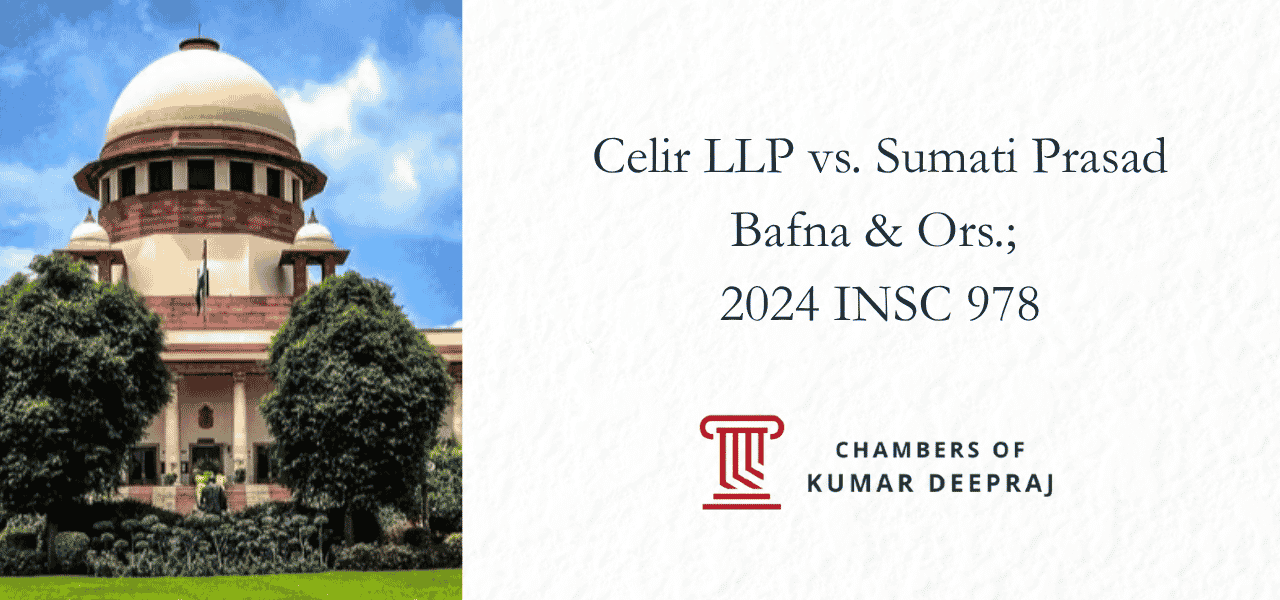
Coram: Justice J.B. Pardiwala and Justice Manoj Misra
Judgment delivered: 13.12.2024
Introduction
The judgment delivered by the Supreme Court of India in Contempt Petition (C) Nos. 158-159 of 2024 provides critical insights into legal principles concerning the Securitization and Reconstruction of Financial Assets and Enforcement of Securities Interest Act, 2002 (SARFAESI Act), issues of auction validity, the doctrine of lis pendens, constructive res judicata with emphasis on Henderson Principle, and contempt jurisdiction
Background and Factual Matrix.
Parties: The petitioner in the present contempt petition, is the successful auction purchaser, the respondent no. 1, Mr. Sumati Prasad Bafna is the original borrower, the respondent no. 4 ‘Greenscape IT Park LLP’ and its director, Mr. Jayesh A. Vavia i.e., the respondent no. 2 herein are the subsequent transferee / third-party purchaser, and the respondent no. 3, ‘Union Bank of India’ is the secured creditor / bank.
Loan Sanction and Security:
A credit facility of ₹100 crore was sanctioned by the Bank to the Borrowers on 03.07.2017 under Lease Rental Discounting (LRD). An additional ₹6.77 crore was sanctioned on 02.01.2020. A simple mortgage was created on a 16,200 sq. m. parcel of land with buildings at Navi Mumbai, Maharashtra, as security via a Mortgage Deed dated 28.01.2020.
Loan Default and NPA Classification:
The Borrower defaulted, and the account was declared a Non-Performing Asset (NPA) on 31.03.2021. On 07.06.2021, the Bank issued a demand notice under the SARFAESI Act seeking repayment of ₹123.83 crore as of 30.04.2023.
Possession and Auctions:
The Bank issued a possession notice on 04.02.2022 under Section 13(4) of the SARFAESI Act and took symbolic possession. Aggrieved by the aforesaid actions of the bank under the SARFAESI Act, the Borrower preferred a Securitization Application being S.A. No. 46 of 2022, under Section 17 of the SARFAESI Act before the Debt Recovery Tribunal assailing the notice(s) dated 07.06.2021 under Section 13(2), and the notice dated 04.02.2022 under Section 13(4), by the Bank, classifying the Borrower’s Account as an NPA and taking symbolic possession of the Secured Asset, respectively. Between March 2022 and June 2023, eight auctions were conducted, all of which failed, as no bidder turned up. On 14.06.2023, the Bank issued a notice for the 9th auction, with a reserve price of ₹105 crore.
Ninth Auction and Proceedings:
The 9th auction was conducted on 27.06.2023, however, the terms of the aforesaid notice of sale, which become germane for the present case, inter-alia stipulated that the Secured Asset would be sold on ‘as is what is and whatever there is basis’ at a reserve price of Rs. 105 crore and that the said auction would be subject to the outcome of the S.A No. 46 of 2022 pending before the DRT. The petitioner herein bid ₹105.05 crore and was declared the highest bidder. The petitioner paid the required amounts: ₹15.76 crore on 01.07.2023 and the balance on 27.07.2023.
Borrower’s Redemption Efforts:
After the 9th auction, the Borrower sought to redeem the mortgage by offering to pay ₹123.83 crore, by filing an via an application to the DRT on 05.07.2023, in the pending appeal. Before the DRT could even pronounced the order on the application seeking redemption of mortgage, the Borrowers approached the Hon’ble Bombay High Court via Writ Petition No. 9523 of 2023, seeking to redeem the mortgage and halt the sale.
High Court Proceedings and Outcome:
Before the High Court, the Borrowers offered ₹129 crore to redeem the mortgage, which the Bank agreed to accept, as it exceeded both the outstanding amount and the auction bid. On 17.08.2023, the High Court allowed the Borrowers to redeem the mortgage, subject to payment of ₹25 crore on the same day and the remaining ₹104 crore by 31.08.2023. If the payment failed, the sale to the petitioner would stand confirmed.
Supreme Court Proceedings in Civil Appeal Nos. 5542-5543 of 2023, and development therein:
Aggrieved by the aforesaid Order of the High Court, the petitioner, approached the Hon’ble Supreme Court, impugning Order dated 17.08.2023, wherein the High Court allowed the Borrower to redeem the mortgage after the 9th auction. The Special Leave Petitions (SLP Nos. 19523-19524 of 2023), was later renumbered as Civil Appeal Nos. 5542-5543 of 2023, was filed on 21.08.2023.
The SLPs were first heard on 25.08.2023, but since the High Court judgment was unavailable, the matter was adjourned to 01.09.2023. No interim relief or stay was granted.On 26.08.2023, the High Court’s judgment was uploaded, and the Borrower redeemed the mortgage by paying ₹104 crore to the Bank.On 28.08.2023, the Bank issued a No Dues Certificate, executed a Release Deed discharging the mortgage, and returned title deeds to the Borrower.
The Borrower also cleared a second charge of ₹15 crore with Tata Motors Financial Solutions Ltd. Subsequently, the Borrower transferred the leasehold rights of the Secured Asset to M/s Greenscape I.T. Park LLP by executing a registered Agreement of Assignment on the same day.
Supreme Court Judgment: On 01.09.2023, the Supreme Court concluded the arguments and reserved its judgment. Written submissions were directed from the parties. The Court’s final judgment on 21.09.2023 held that:
• The High Court erred in allowing redemption of the mortgage after the sale notice under Rule 9(1) of the SARFAESI Rules.
• The High Court’s Order dated 17.08.2023 was set aside.
• The petitioner was directed to pay an additional ₹23.95 crore (to cover the difference between the bid amount and outstanding dues) to the Bank within a week.
• Upon payment, the Bank was to issue a sale certificate for the Secured Asset to the petitioner under Rule 9(6) of the SARFAESI Rules. The Bank was instructed to refund the amount paid by the Borrower for redemption of the mortgage.”
The acts by the parties, which led to the institution of the present contempt petition:
On 26.09.2023, the Borrower filed a Review Petition (R.P. (C) Nos. 611-612 of 2024) against the Supreme Court’s judgment dated 21.09.2023 in Civil Appeal Nos. 5542-5543 of 2023. On the subsequent date, i.e., 27.09.2023, the Petitioner paid ₹23.95 crore as directed by the Supreme Court, and the Bank issued the Sale Certificate for the Secured Asset. On the same day, the Bank requested the Borrower to cancel the Release Deed dated 28.08.2023 and return the original title deeds for refunding the amount paid during the mortgage redemption. The Borrower disputed receiving this communication but was reminded again on 18.10.2023 by the Bank.
The petitioner repeatedly sought physical possession and title deeds of the Secured Asset from the Bank, which cited the Borrower’s non-cooperation. The Bank informed the petitioner about filing an application under Section 14 of the SARFAESI Act (S.A. No. 787 of 2023) to obtain physical possession, pending before the District Magistrate, Thane.
The Borrower, before the DRT, again filed I.A. No. 3220 of 2023 in an earlier securitization application (S.A. No. 46 of 2022) seeking to:
• Bring subsequent developments on record.
• Challenge the Notice of Sale dated 12.06.2023 for alleged non-compliance with SARFAESI Rules.
• Set aside the auction of 30.06.2023 and question the Bank’s actions under SARFAESI Act and Rules.
Furthermore, upon receiving a legal notice from the petitioner on 29.12.2023, the Subsequent Transferee also filed a Special Civil Suit No. 5 of 2024:
• Claiming ownership and title over the Secured Asset.
• Validating the Assignment Agreement dated 28.08.2023.
• Seeking protection against attempts at forceful possession.
Orders by Authorities:
• 02.02.2024: District Magistrate allowed the Bank’s SARFAESI application (S.A. No. 787 of 2023), appointing the Tehsildar, Thane, to take physical possession.
• 14.02.2024: Tehsildar issued a possession notice requiring the Subsequent Transferee to surrender possession within 15 days.
The Borrower filed a Section 17 application under SARFAESI to stay the possession notice and restrain coercive action, despite earlier claiming no role post-transfer.
Tribunal and Civil Court Proceedings:
On 05.02.2024, the Civil Court, Belapur, directed status quo in the suit by the Subsequent Transferee, restraining the Bank from taking possession until its written statement was filed. On 28.02.2024, the DRT ruled against the Borrower, refusing to stay the possession notice and declaring the Borrower’s reliance on the Release Deed dated 28.08.2023 as improper. The Borrower appealed to DRAT, which:
• Ordered status quo on 29.02.2024.
• Directed the Bank to deposit ₹129 crore paid by the Borrower, contrary to the Supreme Court’s earlier direction to refund this amount.
In light of the above, the present Contempt Petition and Miscellaneous Applications were filed.
The Petitioner, alleged, Borrower’s dubious actions, including contradictory stances on possession and title deeds, coupled with the Subsequent Transferee’s lawsuit and interim orders, caused delay in compliance, and therefore sought –
• Physical possession and title deeds.
• Annulment of the Release Deed, No Dues Certificate, and Assignment Agreement.
• Quashing of proceedings pending before DRT, DRAT, and Civil Court.
The Bank cited lack of cooperation from the Borrower and the Subsequent Transferee in handing over possession and title deeds, hence filed M.A. No. 600 of 2024 on 12.03.2024, seeking directions for the Borrower to comply with the Supreme Court’s earlier judgment.
Issues before the Supreme Court
I. Whether any act of contempt could be said to have been committed by the respondent nos. 1 to 4 respectively of the judgment and order dated 21.09.2023 passed by this Court in Civil Appeal Nos. 5542-5543 of 2023? In other words, whether the respondents herein in light of the aforesaid decision of this Court were duty bound to cancel the Release Deed dated 28.08.2023 and hand over the physical possession along with the original title deeds of the Secured Asset to the petitioner herein?
II. Whether, the proceedings arising out of S.A. No. 46 of 2022 could have continued after this Court’s judgment and order dated 21.09.2023 directing the issuance of the Sale Certificate of the Secured Asset to the petitioner herein? In other words, whether the petitioner by virtue of the Sale Certificate dated 27.09.2023 is said to have acquired a clear title to the said property?
III. Whether the transfer of the Secured Asset in favour of the Subsequent Transferee by way of the Assignment Agreement dated 28.08.2023 is hit by lis pendens? In other words, whether the absence of any registration in accordance with Section 52 of the TPA as amended by the State of Maharashtra renders the lis pendens inapplicable?
Supreme Court’s observations:
The Hon’ble Supreme Court, while delving itself to the factual matrix of the present case gazed the following –
• The Borrower initially challenged the Bank’s actions under the SARFAESI Act by filing S.A. No. 46 of 2022 before the DRT. When the Bank issued its 9th auction notice on 12.06.2023, which the Borrower claimed to have received on 14.06.2023, the Borrower also contested this notice by filing I.A. No. 2253 of 2023 within the same securitization application.
• Before the DRT could decide the matter, the Borrower independently approached the High Court through Writ Petition No. 9523 of 2023. The Borrower sought the High Court’s intervention to either resolve the entire issue itself or direct the DRT to finalize the matter and then allow the Borrower to redeem the mortgage.
• During the High Court proceedings, the Borrower voluntarily gave up its right to pursue S.A. No. 46 of 2022, regardless of whether it could redeem the mortgage. Consequently, the High Court permitted the Borrower to redeem the mortgage and directed it to withdraw S.A. No. 46 of 2022 within one week. The High Court clarified that failure to withdraw would result in the automatic dismissal of the application, precluding further litigation on the Secured Asset.
• By the time the Supreme Court reserved its judgment in the Main Appeals on 01.07.2023, the one-week deadline had passed, but the Borrower had not withdrawn S.A. No. 46 of 2022. Despite claiming compliance with the High Court’s order in its submissions, the Borrower failed to fulfill this requirement.
During the Main Appeals, the petitioner (successful auction purchaser) argued that:
• The Borrower’s right to redeem the mortgage had lapsed under the law.
• The High Court’s order should be overturned
• The Bank should issue a sale certificate to finalize the sale in the petitioner’s favor.
Despite being aware of these arguments, the Borrower did not object to the sale being confirmed in the petitioner’s favor or challenge the auction process on the grounds of procedural irregularities, such as the lack of a proper time gap between the notice of sale and the auction.
Although the Borrower claimed during the hearing that the matter had become moot due to compliance with the High Court’s order, it never indicated that it was actively withdrawing S.A. No. 46 of 2022.
The Borrower did not request that its right to pursue S.A. No. 46 of 2022 be safeguarded or that the issuance of the sale certificate be contingent on the application’s outcome, even though this would have rendered the application irrelevant.
The Borrower also failed to raise objections during the hearing or in its submissions regarding alleged procedural violations in the auction process, such as inadequate time between the notice and the auction or the conditionality of the auction being subject to the outcome of S.A. No. 46 of 2022.
In summary, the Borrower’s actions reflect inconsistencies and missed opportunities to assert its rights, including a failure to comply with the High Court’s directives and to raise critical objections during the Supreme Court proceedings.
ANALYSIS OF THE SUPREME COURT:
THE DECISION OF THIS COURT IN CELIR LLP V. BAFNA MOTORS & ORS. (2023 INSC 838) AND THE SCOPE OF CHALLENGE BEFORE IT.
The Supreme Court examined the Borrower’s actions in challenging the Bank’s measures under the SARFAESI Act and the resulting implications. Initially, the Borrower had sought relief for redeeming the mortgage through S.A. No. 46 of 2022 before the DRT. This application could fully address the Borrower’s grievances under Section 17 of the SARFAESI Act, which provides a comprehensive legal framework for resolving disputes related to actions taken by secured creditors.
However, instead of allowing the DRT to adjudicate the matter, the Borrower later approached the High Court through a writ petition, seeking essentially the same relief. By doing so, the Borrower effectively abandoned its case before the DRT, as pursuing parallel remedies for the same issue is not permissible. Under the Doctrine of Election, once the Borrower chose to litigate the matter in the High Court, it could no longer pursue the same cause of action in the DRT to avoid duplicative or conflicting rulings.
When the High Court’s order allowing redemption of the mortgage was challenged before the Supreme Court in the Main Appeals, the Borrower failed to contest the validity of the SARFAESI proceedings or the auction process. Neither in oral arguments nor written submissions did the Borrower address issues such as the legality of the 9th auction notice or procedural compliance. Consequently, the Supreme Court limited its deliberations to the Borrower’s right to redeem the mortgage under Section 13(8) of the SARFAESI Act. The Court held that under the amended provision, the right to redemption ceases upon the publication of the auction notice, which had already occurred in this case. Thus, the Borrower was not entitled to redeem the property.
The Supreme Court subsequently set aside the High Court’s order and directed the issuance of a sale certificate for the secured asset to the auction purchaser. Despite this, the Borrower, in its review petition, failed to raise any challenges related to the auction’s legality or the SARFAESI proceedings. The review petition was ultimately dismissed on 18.07.2024.
Given this history, the Supreme Court emphasized that the Borrower cannot now raise these issues in subsequent proceedings, such as a contempt petition or the still-pending S.A. No. 46 of 2022 before the DRT. The Borrower’s failure to address these points earlier precludes any further litigation on these matters.
THE ‘HENDERSON’ PRINCIPLE AS A COROLLARY OF CONSTRUCTIVE RESJUDICATA.
The Henderson Principle is fundamentally aimed at preventing abuse of judicial process. The core idea is that a party cannot re-litigate issues or claims that were, or could have been, raised in prior proceedings.
Two Central Components:
• Finality of Judicial Decisions:
Once a case is decided, the matter should be closed to avoid conflicting judgments or repetitive litigation. This ensures that the judicial system is not burdened with repeated cases on the same issue, preserving the integrity and finality of court decisions. This aspect of the principle stems from the idea that judicial decisions should provide a definitive resolution, allowing the community and the parties involved to move forward without the threat of recurring litigation.
• Avoidance of Multiple and Vexatious Legal Challenges:
To prevent the multiplication of litigation, the principle holds that parties should not be allowed to continue raising issues that they could have raised in previous proceedings. This includes matters that could have been raised but were deliberately or negligently omitted. Allowing successive legal actions on the same issue could lead to legal fragmentation and oppressive litigation, where the same parties keep raising similar claims or issues in different proceedings. This could not only overwhelm the judicial system but also cause undue hardship for the opposing party.
Key Terms Related to the Henderson Principle:
• Constructive Res Judicata: This term extends beyond issues explicitly decided in prior proceedings to those issues that could have been raised but were not. It reflects the principle that issues already available in earlier litigation should not be revisited in subsequent actions. The idea here is to prevent strategic litigation, where a party might withhold an issue in one action to raise it later in another action.
• Application in Court Practice: The principle is applied to prevent parties from abusing the judicial system by deliberately splitting issues across different cases, in order to maximize litigation opportunities or delay resolution. A court may dismiss a subsequent case if the issues raised in it could have been, but were not, raised in earlier proceedings. This prevents a party from trying to obtain a second bite at the apple through separate actions or forums.
Application of the Henderson Principle in the present case:
• Doctrine of Res Judicata: The Supreme Court held that the Borrower had previously challenged the Bank’s actions in earlier proceedings but chose not to raise certain issues during those proceedings. These issues included the validity of the 9th auction and the legal measures taken by the Bank under the SARFAESI Act. The principle of res judicata prevented the Borrower from raising these issues in subsequent litigation, as they were deemed to have already been part of the subject matter of earlier cases. The court emphasized that the Borrower could not be allowed to revisit these claims by splitting issues across different legal proceedings.
• Constructive Res Judicata: The court found that the issues raised in subsequent litigation, related to the auction process, could have been addressed earlier but were deliberately omitted by the Borrower. Thus, these issues were seen as constructively res judicata, as they were not raised earlier but were part of the same cause of action and should have been included in the initial proceedings. The principle also prevents a party from holding back certain arguments or grounds with the intention of raising them at a later stage, after a court has already decided a related issue.
• Doctrine of Election: The Borrower had the option to pursue remedies under the SARFAESI Act, but having failed to do so, it could not challenge the same SARFAESI proceedings in later litigation. The Doctrine of Election holds that a party must choose between two inconsistent remedies and cannot pursue both. The Borrower could not choose one remedy and, after failing to obtain relief, then pursue a different and inconsistent remedy in a subsequent legal proceeding. This was seen as inconsistent conduct and a violation of the principle that a party must act in good faith and pursue all available claims at the earliest opportunity.
• Abuse of Process: The Borrower’s attempt to reintroduce issues that it had previously abandoned in favor of pursuing other legal avenues was considered an abuse of process. The court emphasized that piecemeal litigation—where issues are fragmented into separate proceedings to gain an unfair advantage—undermines the integrity of the judicial process.By not raising the validity of the auction notice in the earlier proceedings, the Borrower was found to have effectively waived those issues, and their later attempts to resurrect them were ruled impermissible.
• Merger Doctrine and Judicial Integrity: The Doctrine of Merger was invoked, asserting that once a matter is litigated and a judgment is passed, all issues and claims related to that case merge into the final judgment. The Borrower, by choosing to litigate one matter (the redemption of the mortgage) in one forum (the DRT), could not later use another forum (the High Court) to relitigate the same issue or claim. The principle of judicial integrity also underpinned the judgment, with the court asserting that allowing the Borrower to repeatedly challenge the Bank’s actions would undermine the finality of judicial decisions and contribute to procedural manipulation.
The Supreme Court eventually, held after applying the Henderson Principle, and the Doctrine of Constructive Res Judicata, that the Borrower was barred from raising the issue of the validity of the auction proceedings because it was relevant to the cause of action and should have been addressed in earlier proceedings. The Sale Certificate issued to the Secured Asset was final, and the Borrower could not dispute it after the matter had been adjudicated. The Borrower’s conduct in seeking inconsistent remedies or pursuing issues it had abandoned earlier was found to be a clear case of abuse of process, and their attempts to continue litigation after making a prior election were rejected.
APPLICABILITY OF LIS PENDENS IN THE ABSENCE OF ANY REGISTRATION AS REQUIRED UNDER THE STATE AMENDMENT TO SECTION 52 OF THE TPA.
The Court held that the doctrine of lis pendens comes into effect when a proceeding is filed, irrespective of whether the filing is defective or notice has yet to be issued. This means that any transfer made during the pendency of a legal proceeding is subject to the outcome of the litigation. The case reinforced that lis pendens applies from the moment the proceedings are instituted, and not when the notice is issued.
In the present case, since the Special Leave Petitions (SLPs) were already filed and pending before the Court on 28.08.2023, when the Assignment Agreement was executed, the transfer of the Secured Asset under that agreement was unequivocally affected by the lis pendens doctrine.
The Subsequent Transferee, however, argued that Section 52 of the Transfer of Property Act (TPA) has a modified application in Maharashtra under the Bombay Amendment Act of 1939, which requires the registration of a notice of pendency for lis pendens to apply. The Subsequent Transferee contended that since no such notice was registered, the doctrine of lis pendens would not apply to the transfer.
While acknowledging the state amendment, the Court emphasized that the purpose of the registration requirement is to ensure third-party protection by making the pendency of proceedings known to potential buyers. However, the Court held that the absence of a registered notice does not completely negate the application of lis pendens. Even without the notice, the doctrine can still apply, particularly in cases where the third party is aware of the proceedings and attempts to transfer property during its pendency.
The Court noted that the Subsequent Transferee was aware of the pendency of the proceedings at the time of executing the Assignment Agreement. The Court also highlighted the importance of due diligence by third parties and stated that the absence of notice registration should not automatically protect a party who deliberately avoids the legal process. The Court also invoked the doctrine of pari delicto (in equal fault, the law aids neither party), which implies that the Subsequent Transferee, despite their claim, cannot benefit from the fault of other parties in failing to properly implead them in the case.
In conclusion, the Court ruled that the Assignment Agreement of 28.08.2023, despite the lack of notice registration, was still hit by the doctrine of lis pendens, as the proceedings were pending at the time of the transfer, and the Subsequent Transferee had knowledge of the pendency. The transfer was thus subject to the outcome of the litigation, and the Borrower’s rights to transfer the Secured Asset were rendered non-existent when the High Court’s order was later set aside by the Supreme Court.
WHETHER ANY CONTEMPT IS SAID TO HAVE BEEN COMMITTED BY THE RESPONDENTS HEREIN?
The Supreme Court, explored the concept of contempt of court and the legal obligations tied to judicial orders, especially in the context of a case involving a Borrower and Subsequent Transferee. The key argument presented by these parties is based on the decision in Patel Rajnikant Dhulabhai & Anr. v. Patel Chandrakant Dhulabhai & Ors. reported in (2008) 14 SCC 561, where the Court clarified that to hold someone in contempt, there must be willful disobedience of a clear court order. The Court’s ruling in that case emphasizes that contempt can only be proven if there has been disobedience of a court order that was deliberately ignored.
In the context of the present case, the court expands on this, arguing that even if no specific prohibitory order was given to the Borrower or Subsequent Transferee, their actions aimed at frustrating the court’s order could still be viewed as contemptuous. The Court highlights that contempt is not just about disobedience of an explicit order but also about obstructive or manipulative behavior that undermines the authority of the judiciary and disrupts the course of justice.
Further, the Court stresses that any attempt to nullify or evade the court’s decision is considered contempt, regardless of whether a prohibitory order or directive is explicitly given. The Court also makes it clear that courts have the duty to maintain the dignity and authority of the judicial system, and any actions that hinder the execution of court orders—whether direct or indirect—amount to contempt.
Moreover, the Court addresses the importance of ensuring clarity when orders are issued. If an order lacks clarity, the appropriate course is to seek clarification from the issuing court, rather than interpreting the order in a manner that suits one’s interests.
The Court also critiques the actions of the Borrower and Subsequent Transferee for their attempts to prevent the execution of the judgment passed in September 2023. These actions included attempts to stop the transfer of the secured asset to the petitioner, issuing letters to various authorities to block the process, and filing lawsuits that contradicted the Court’s directives.
Despite these violations, the Court acknowledges the Borrower and Subsequent Transferee’s efforts to make amends, such as withdrawing certain legal suits and promising future compliance with the Court’s orders. As a result, the Court refrains from holding them in contempt at this stage, giving them an opportunity to comply with the order moving forward.
The Supreme Court has underscored that contempt of court is not just about ignoring specific orders but includes any attempt to undermine or bypass judicial authority, and that such actions must be discouraged to uphold the rule of law. The Court also stresses that it is the duty of all parties to obey the spirit of the judgment, not just its literal terms, and to seek clarification when in doubt rather than act based on self-serving interpretations.
WHEN A SALE OF PROPERTY BY AUCTION OR OTHER MEANS UNDER THE SARFAESI ACT MAY BE SET-ASIDE AFTER ITS CONFIRMATION?
The Supreme Court also catch hold of this opportunity to address the issue of when a sale of a secured asset under the SARFAESI Act may be challenged or set aside after its confirmation. Key points from several cases were summarized to establish that once a sale is confirmed, it becomes absolute, and the title vests in the auction purchaser. In B. Arvind Kumar v. Govt of India, (2007) 5 SCC 745, it was held that a sale certificate issued after the confirmation of the auction is evidence of title and does not require further registration.
In LICA (P) Ltd. v. Official Liquidator, (1996) 85 Comp Cas 788 (SC), the Court emphasized that the purpose of an auction is to get the highest possible price, and interference should only occur in cases of fraud, underbidding, or other serious irregularities. Valji Khimji and Company v. Official Liquidator of Hindustan Nitro Product (Gujarat) Ltd. & Ors, reported in (2008) 9 SCC 299 reinforced that once an auction is confirmed, objections should only be entertained on limited grounds like fraud. Similarly, in Ram Kishun v. State of UP (2012) 11 SCC 511, it was held that the sale can only be set aside if a fundamental procedural error occurred or if the sale certificate was obtained through fraud or misrepresentation.
Further, in PHR Invent Educational Society v. UCO Bank, (2024) 6 SCC 579 it was reiterated that a confirmed auction sale can only be interfered with if there is fraud or collusion. In V.S. Palanivel v. P. Sriram, 2024 INSC 659, the Court emphasized that repeated interferences in confirmed auctions cause uncertainty and frustrate their purpose, and courts should only intervene in cases of serious flaws like fraud or grave irregularities.
In the present case, the Borrower did not raise any concerns about fraud, collusion, or underbidding in the 9th auction conducted by the Bank, and no fundamental procedural errors were found, despite a slight irregularity regarding the statutory notice period. The Borrower also failed to express a desire to redeem the mortgage during the auction process. Therefore, the Court confirmed the sale and directed the issuance of the sale certificate.
The Court concluded that sales in auction should not be set aside unless there is a significant procedural error or fraud. Even if an auction is found to be flawed later, the auction purchaser’s rights remain unaffected. A similar principle was stated in Janak Raj v. Gurdilal Singh, AIR 1967 SC 608, where it was held that a successful auction purchaser’s rights would remain intact even if the decree leading to the auction was later set aside.
To access the entire judgment, click here