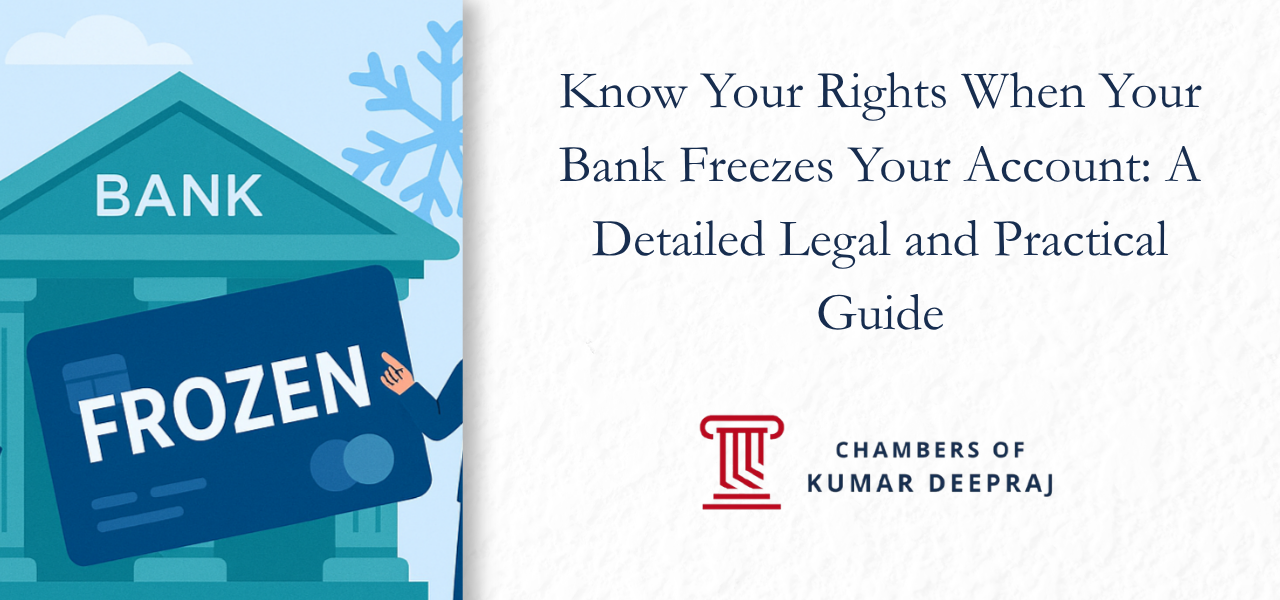
Imagine waking up one morning to find your bank account inaccessible. Your debit card declines; online payments fail. For many, this is not just a financial inconvenience; it’s a full-blown crisis. In a world increasingly dependent on digital banking, the sudden freezing of a bank account can throw an individual or business into chaos. It’s not merely a pause in financial transactions; it can derail loan repayments, payroll disbursements, EMIs, and disrupt day-to-day life. More crucially, it can infringe on your fundamental rights. A frozen account might arise from a regulatory action, a tax notice, enforcement proceedings, or even an incorrect internal flag by the bank. But here’s the good news: you do have rights. In today’s digital economy, bank account freezes are increasingly common, triggered by suspected fraud, regulatory action, or court orders. While some of these actions are legally justified, many violate due process. This blog unpacks your legal rights when your bank freezes your account, the remedies available, and how to navigate this banking deadlock legally and smartly. We delve into statutory provisions, key judgments, procedural rights, remedies, and real-world solutions. This is not just a summary of laws but a guide to your actual rights, legal strategy, and redress mechanisms. The article spans banking regulations, constitutional safeguards, and case-specific tactics, offering a complete roadmap for individuals, businesses, and legal practitioners.
What is a Frozen Account?
A frozen bank account refers to an account that remains open but is rendered inoperable. You cannot withdraw money, issue cheques, make UPI or card payments, or transfer funds. However, deposits may still continue unless explicitly barred. This measure is taken by the bank on its own or upon instruction from enforcement agencies or the judiciary. This action is typically taken under:
> Suspicion of unlawful activity (e.g., money laundering, cyber fraud)
> Regulatory directions (e.g., under the Income Tax Act, FEMA, PMLA)
> Court orders (e.g., attachment proceedings)
> Bank’s internal alerts or error flags (e.g., KYC non-compliance)[1]
Freezing differs from closing an account. A closed account ceases to exist. A frozen account continues to accrue interest (if applicable), allows deposits, but disallows withdrawals. Technically, it is a preventive or protective measure until further investigation or instructions. The Reserve Bank of India (RBI) has issued circulars instructing banks not to block accounts arbitrarily. RBI Master Circular on KYC Norms as updated in 2023 states that Banks must give reasonable notice, cite grounds for freezing, and offer the customer an opportunity to rectify discrepancies.
Legal Framework in India: Who Can Freeze Your Account?
In India, a bank cannot arbitrarily freeze a customer’s account. Such action must stem from a legal or regulatory mandate.
> The Prevention of Money Laundering Act, 2002 (hereinafter, PMLA)
Under Section 17 of the PMLA, if the Enforcement Directorate (ED) suspects the proceeds of crime are held in a bank account, it may direct the bank to freeze the account pending investigation.[2] The pre-requisites, for freezing a bank account under the PMLA are –
> Reason to believe recorded in writing.
> Authorization from a senior official.
> Prompt communication to the person affected.
However, it was held in M.K. Shah Engineers & Contractors v. Assistant Director, Directorate of Enforcement,[3] the Supreme Court emphasized that seizure under PMLA must follow safeguards like proper authorization and a copy of the seizure order served to the affected party.
Practical Note: If you believe your account was frozen under PMLA, demand a copy of the seizure order, and file a representation explaining the lawful origin of funds.
> The Income Tax Act, 1961
Section 132(3) empowers tax authorities to place prohibitory orders on assets, including bank accounts, during a tax raid[4], and Section 281B, also empowers the Authority to provisionally attaches property to protect interests of revenue. In KCC Software Ltd. v. Director General of Income Tax (Investigation),[5] the Supreme Court held that indiscriminate freezing without proper reasons or delay in revocation violates the taxpayer’s rights.
Practical Note: Taxpayers must promptly respond to notices and can approach the jurisdictional Principal Commissioner for early revocation.
> The Foreign Exchange Management Act, 1999 (FEMA)
The Directorate of Enforcement, under FEMA, can freeze accounts suspected of foreign exchange violations;[6] however, Orders must be reasoned, notified to the person affected, and subject to judicial review. Procedural compliance is a must, failure to notify the account holder can lead to illegality.
> Bharatiya Nyaya Sanhita, 2023
In order to combat fraudulent financial practices, Section 318(4)of the Bharatiya Nyaya Sanhita, 2023[7] penalizes those who deceive and dishonestly persuade others to transfer property or manipulate valuable securities. In order to prevent those involved in such fraudulent actions from continuing to take advantage of financial systems while investigations are being conducted, this provision offers a framework for freezing accounts involved in such crimes.
> The Bharatiya Nagarik Suraksha Sanhita, 2023
Section 106 of the Bharatiya Nagarik Suraksha Sanhita, 2023[8] gives police officers the authority to confiscate assets, including bank accounts, if they believe they are connected to illegal conduct. This clause is similar to the previous Code of Criminal Procedure, 1973 (CrPC) Section 102, which gave police officers the authority to confiscate any property they thought was related to a crime. In cybercrime investigations, this section is very important since it allows law enforcement to get financial evidence and stop additional criminal activity.
In M.T. Enrica Lexie v. Doramma,[9] the Supreme Court clarified that under Section 102 of the CrPC, seizure applies to: (a) stolen or suspected stolen items, and (b) property directly linked to a crime. This was elaborated in State of Maharashtra v. Tapas D. Neogy,[10] where the Court held that two conditions must be met:
> the existence of a “property”, and
> a reasonable suspicion connecting that property to the offence.
Thus, freezing a bank account under Section 102 requires a demonstrable link between the account and the alleged offence, backed by substantive material indicating reasonable suspicion.
Due Process: What Are The Available Rights?
Freezing a bank account impacts your right to livelihood and right to property, both protected under Article 21 and Article 300A of the Constitution of India. Every person has the right to life and personal liberty under Article 21 of the Indian Constitution,[11] which includes protection from acts that negatively impact their livelihood or mental health. Section 106 of the BNSS, 2023[12] mandates that authorities freeze accounts in accordance with due process. Any capricious or unwarranted account freezing that lacks sufficient proof or appropriate protocols may be contested as an abuse of authority.
In Muktaben M. Mashru vs. State of NCT of Delhi and Ors.,[13] the Delhi High Court noted:
“ …the reporting of the freezing of bank accounts is ‘mandatory.’ Failure to do so, apart from other conditions, will vitiate the freezing of the bank account, which should be ‘forthwith’ reported to the concerned Magistrate. Non-compliance with this mandatory requirement goes to the root of the matter. If there is any violation in following the procedures under Section 102 of the Cr.P.C., the freezing of the bank accounts cannot be legally sustained.”
The Madras High Court ruled in B. Kavitha v. The Inspector of Police[14] that inappropriate account freezing without following procedural protections is a misuse of power that can result in sanctions for the officials involved.
> Representation before the Investigating Agency
Making a formal representation to the relevant authority such as the police, cybercrime cell, or any other investigative agency is the first step in dealing with a frozen bank account. This entails getting clarification on the grounds for the account’s freeze as well as presenting proof of the funds legal origin and intended use. Contact the bank and request the reason in writing. Under the RBI’s directions and consumer protection norms, banks must disclose the cause unless restrained by law enforcement confidentiality.
> Relief before the Magistrate
If a bank account is frozen, the person in question may contact the magistrate in accordance with Section 497 or Section 503 of the B.N.S.S. to request relief. These clauses permit the return of confiscated assets, such as bank accounts, to their legitimate owners. In accordance with B.N.S.S. Section 497,[15] the magistrate has the authority to order the temporary possession or disposition of property while an investigation, inquiry, or trial is ongoing. The Magistrate is expressly authorized by Section 503 of B.N.S.S.[16] to give the seized property, under the proper circumstances, to the rightful owner.
> Challenge before High Court
Article 226 of the Indian Constitution allows for the filing of a Writ Petition to execute a writ of mandamus, contesting activities that violate the fundamental rights protected by Articles 21, 19(1)(g), and 14. The rights to life and personal liberty, including the preservation of one’s means of subsistence, are guaranteed under Article 21.[17] This clause allows people to contest asset freezes, such bank account seizures, that impair their capacity to make a living or jeopardize their financial stability. The Hon’ble Madras High Court ruled in Mohammed Saifullah vs. Reserve Bank of India[18] that an investigative agency cannot freeze a person’s whole bank account if they are suspected of financial crime without first determining how much money is directly related to the alleged fraud. The Court noted that a complete freeze of this kind would violate the fundamental rights to livelihood and to commerce and business.
Best Practices for Account Holders
> Keep your KYC updated and notify the bank of changes in address, contact, and PAN.
> If involved in litigation or tax proceedings, inform your bank to avoid surprise freezes.
> Don’t ignore notices, respond promptly to any communication from enforcement or tax authorities.
> If wrongly targeted, consult a legal expert before replying or filing any petition.
> In case of suspected cybercrime or fraud, register an FIR immediately to establish your non-involvement.
Conclusion
A frozen bank account is not just a minor inconvenience, it can disrupt livelihoods, ruin businesses, and violate fundamental rights. But as this blog shows, you are not helpless. Whether it’s under RERA, FEMA, PMLA, or tax laws, there are legal safeguards in place. Courts have consistently upheld that due process, fairness, and the right to be heard are non-negotiable, even in financial regulations. So, if your bank freezes your account- don’t just accept it. CHALLENGE IT! Because your bank account is not just a number, it’s your financial freedom.
Disclaimer: This article is intended for informational purposes only and does not constitute legal advice. For specific cases, consult a legal professional.
[1] What is a Frozen Account? What causes it and How to Unfreeze it? Investopedia, available at: https://www.investopedia.com/terms/f/frozenaccount.asp.
[2] The Prevention of Money Laundering Act, No. 15 of 2003,§ 17(1)(iv).
[3] M.K. Shah Engineers & Contractors v. Assistant Director, Directorate of Enforcement, 2022 SCC OnLine SC 1244.
[4] The Income Tax Act, No. 43 of 1961, § 132(3).
[5] KCC Software Ltd. v. Director General of Income Tax (Investigation), (2008) 12 SCC 157.
[6] The Foreign Exchange Management Act, No. 42 of 1999, § 37.
[7] The Bhartiya Nyaya Sanhita, No. 45 of 2023, §318(4).
[8] The Bharatiya Nagarik Suraksha Sanhita, No. 46 of 2023, §106.
[9] M.T. Enrica Lexie v. Doramma, (2012) 13 SCC 780.
[10] State of Maharashtra v. Tapas D. Neogy, (1999) 7 SCC 685.
[11] India Const. art. 21.
[12] The Bhartiya Nyaya Sanhita, No. 45 of 2023, §106.
[13] Muktaben M. Mashru vs. State of NCT of Delhi and Ors., 2019 SCC OnLine Del 11509.
[14] B. Kavitha vs. The Inspector of Police, MANU/TN/4197/2019.
[15] The Bharatiya Nagarik Suraksha Sanhita, No. 46 of 2023, §497.
[16] The Bharatiya Nagarik Suraksha Sanhita, No. 46 of 2023, §503.
[17] Supra note 11.
[18] Mohammed Saifullah vs. Reserve Bank of India, W.P. No. 25631 of 2024.