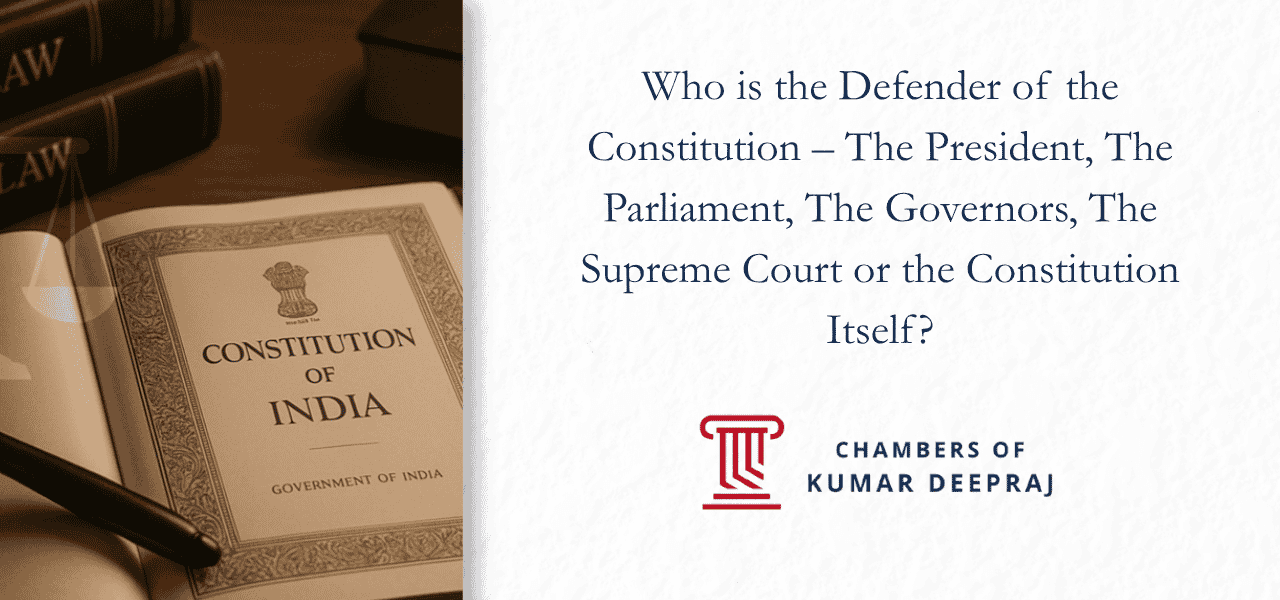
In recent years, especially in the evolving political and constitutional discourse of India, the question has increasingly emerged: who is the true defender of the Constitution? Is it the President, entrusted with upholding constitutional values? The Parliament, which enacts laws in accordance with the Constitution? The Governors, as the executive heads in states? The Supreme Court, as the final interpreter and guardian of constitutional provisions? Or the Constitution itself, through its self-enforcing structures and doctrines?
This article aims to explore this question in the wake of recent developments — notably the Hon’ble Supreme Court’s judgment in State of Tamil Nadu v. The Governor of Tamil Nadu & Anr., 2025 INSC 481, and the recent comments made by the Learned Vice President on Article 142 of the Constitution. These events reignite the debate surrounding institutional roles in a constitutional democracy, particularly in the context of federalism, separation of powers, and checks and balances. The article also includes a comparative and theoretical framing, informed by constitutional philosophy and international models, to enrich our understanding of constitutional guardianship.
I. Constitutional Architecture: A Brief Overview
To understand who defends the Constitution, we must first understand its architecture. The Indian Constitution envisages a democratic republic governed by the rule of law, incorporating separation of powers between the Legislature, Executive, and Judiciary, while also ensuring cooperative federalism.
a) The President: Article 60 of the Constitution requires the President ‘to preserve, protect, and defend the Constitution and the law’. This oath is not merely symbolic — it signals the constitutional expectation that the President, as the head of state, is a trustee of the constitutional order. While the President acts on ministerial advice, occasional interventions — such as returning a Bill or seeking judicial guidance — reflect a limited but meaningful constitutional role.
b) The Upper and Lower House: As the law-making body, the Lok Sabha and the Rajya Sabha plays a critical role in translating the will of the people into enforceable statutes. However, its powers are circumscribed by the Constitution itself, particularly the basic structure doctrine. Its status as defender of the Constitution depends heavily on its fidelity to constitutional morality and representative accountability.
c) The Governors: Appointed by the President on the aid and advice of the Council of Ministers, the Governors are the constitutional heads of states. Their role has come under scrutiny for alleged partisan conduct, particularly in delaying or obstructing bills passed by state legislatures. The constitutional vision, however, expects them to function as neutral constitutional umpires, not political agents, which may not been the case in the recent past.
d) The Supreme Court: Articles 32, which Dr. B. R. Ambedkar refers as the ‘soul of the Constitution’ confer upon the Supreme Court the power to enforce fundamental rights and correct constitutional wrongs. Supreme Court is the custodian of the Constitutional Rights, more particularly, the fundamental rights. Article 32 is not confined to only the 5 types of writs, which the Supreme Court can issue, but, the scope is much larger[1]. Similarly, Article 142 empowers the Court to do “complete justice.” Through these, the Court assumes a dynamic role — not only as interpreter, but as enforcer and guardian.
e) The Constitution Itself: Through its built-in structures — including judicial review, federalism, and accountability mechanisms — the Constitution has embedded safeguards against its own erosion. These doctrines operate like a self-regulating conscience of the polity. The Constitution self-guards itself from all possible destructive forces. It has not given unlimited power to any institution. Even the parliament cannot amend its basic structure. The Supreme Court also cannot do away with the constitutional principles – the parliament can keep in check. Similarly, the Executive is also being monitored by the Parliament as well as by the Judiciary. Eventually, it is the Constitution, which is the real ring master
II. Theoretical Foundations: Law as Integrity and Constitutional Morality
Before we analyse institutional roles, it is helpful to recall key theoretical underpinnings. Ronald Dworkin’s theory of “law as integrity” proposes that law should be interpreted not merely by its text but by moral principles consistent with justice and fairness. In the Indian context, Dr. B.R. Ambedkar’s articulation of “constitutional morality” emphasizes adherence to democratic norms, mutual respect between institutions, and non-arbitrariness in governance.
These frameworks elevate the Constitution beyond a legal document — transforming it into a moral and political compass for state functionaries.
III. The Supreme Court’s Judgment in State of Tamil Nadu v. Governor of Tamil Nadu
The landmark judgment delivered on 08th April 2025 addresses the issue of gubernatorial inaction with regard to Bills passed by the Tamil Nadu Legislative Assembly. The Governor had failed to act on multiple Bills, leading to a constitutional impasse. The Supreme Court reaffirmed the principle that Governors are bound by constitutional morality and must act within a “reasonable time” while dealing with legislative business. The Court held that the role of the Governor is not that of an adversary to the elected government.
The deliberate delay being caused by the Governors in States having Non – BJP governments, could have been ignored this long. Delay in giving accent, is eventually stalling the law making process of a State, and therefore, a constitutional crisis. As stated above, if one faction of the Constitution is causing the hindrance in the constitutional framework, the other fraction has to come to an aid. This is how the constitution would work smoothly. This is not the first time, that the Supreme Court has given any direction to the President. There have been numerous instances, be it setting aside President’s Rule imposed under Article 356, or directing to decide Mercy Petitions of the death row convicts, etc.
Key Takeaways from the Judgment:
i) Governors cannot sit on Bills indefinitely; such inaction violates constitutional propriety.
ii) The constitutional role of the Governor is to act on the aid and advice of the Council of Ministers, barring limited exceptions.
iii) The Supreme Court held that unreasonable delays frustrate legislative intent and democratic mandate.
This case highlights the judiciary’s indispensable role in enforcing constitutional discipline on constitutional functionaries and preserving the legislative sanctity of elected bodies.
IV. The Role of Article 142 and the Vice President’s Remarks
In a controversial remark, the Hon’ble Vice President referred to Article 142 of the Constitution — which empowers the Supreme Court to pass any decree to do “complete justice” — as a “nuclear missile.” Not only the Vice President, who himself has been a Senior Advocate, stated these adjectives in an open session, but proudly shared the extracts of his speech on his official twitter handle as well.
The comparison, while perhaps intended metaphorically, raises serious concerns about the perceived overreach of judicial powers. Senior Advocate Kapil Sibal and others have strongly criticized the analogy, arguing that such comments undermine the judiciary’s constitutional role. The post of Vice President is itself ceremonial, who has no independent powers, as such, and therefore a person who himself, have taken the oath to abide by the Constitution, must not make these comments, which hurts the constitutional sentiments.
Relevance of Article 142: Article 142 is a unique provision enabling the Supreme Court to transcend procedural limitations to ensure justice. Its usage, although rare, has played a pivotal role in landmark cases like Union Carbide, Ayodhya – Ram Janam Bhoomi, and electoral disqualifications. While criticism of judicial activism is legitimate in a democracy, reducing the Court’s powers to dangerous weaponry risks damaging public confidence in constitutional adjudication.
V. The President as Defender: Symbolic or Substantive?
While the President’s oath mandates defense of the Constitution, Article 74 obliges the President to act on ministerial advice. This creates a symbolic rather than autonomous constitutional position.
Nevertheless, subtle but significant instances — such as requesting reconsideration of legislation or raising constitutional queries — reveal that the office can still embody constitutional conscience, particularly in transitional or contested moments.
Furthermore, a person being appointed as a President is practically being nominated by the Party who is in power in the Centre, and therefore, we have been instances, in the past since independence of President being acting to the tune of the Political Party. It is correct, that the President has to act on the advice of Prime Minister and his Council of Ministers, however, the act has to be done within the constitutional framework, and not mindlessly.
VI. Parliament’s Position: Will of the People or Majoritarian Threat?
Parliament, as the voice of the people, has the authority to legislate. Yet, constitutional amendments and laws passed must adhere to the basic structure doctrine laid down in Kesavananda Bharati v. State of Kerala, 1973 4 SCC 225.
While Parliament can amend the Constitution, it cannot destroy its core values. Therein lies the tension — Parliament is both a powerful force for democratic change and, potentially, a majoritarian threat when unchecked by constitutional limits. Hence, tomorrow, even if the majority wants to go away with Article 142 or 32, it cannot, as it will amount to encroaching into the constitutional soul, which the constitution doesn’t allow.
VII. Governors and Constitutional Morality
The recent judgment is not the first time the conduct of Governors has been called into question. Whether it is inviting parties to form governments or delaying assent to Bills, the role of Governors has sparked political and legal controversy. Reports like the Sarkaria and Punchhi Commissions have consistently emphasized the need for Governors to act neutrally. Judicial precedents like Nabam Rebia & Anr. v. Deputy Speaker, AIR 2016 SC 3209 reinforce the same. Failure to adhere to constitutional morality in gubernatorial conduct threatens federal harmony.
VIII. The Supreme Court: Guardian, Interpreter, Enforcer
The Supreme Court of India, through its expansive jurisdiction, plays a multifaceted role — not just interpreting but also enforcing constitutional mandates. It is the final arbiter on constitutional validity and rights enforcement.
From Kesavananda Bharati to S.R. Bommai, I.R. Coelho, and the recent Tamil Nadu Governor case, the judiciary has time and again acted as a counter-majoritarian force.
IX. Can the Constitution Defend Itself?
The Constitution is not merely a text; it is a living entity. Its self-preserving doctrines — basic structure, judicial review, constitutional morality — offer internal safeguards. Yet, it requires active defence by institutions. Without institutional fidelity, these doctrines remain dormant. Thus, the Constitution’s ability to defend itself is inherently relational — it depends on those who operate within its framework. If the institutions itself surrenders to the majority, then the Constitution might not able to save itself. The sentinel has to be on guard. If the sentinel itself becomes corrupt, or give away its powers, the Constitution will not survive. Hence, in order to defend itself, the Constitution requires its commanders – Legislature, Executive, and Judiciary, to guard it.
X. Interdependence and Institutional Synergy
No single institution can claim a monopoly on defending the Constitution. It is a shared responsibility, requiring collaboration, restraint, and mutual respect. When any branch oversteps or abdicates, constitutional erosion follows. The oath ceremony of President, Chief Justice of India, and/or Prime Minister exhibits this. The oath taker and the giver are interchangeable.
As Ambedkar warned, constitutional morality must override popular passion. Institutional synergy — grounded in respect and restraint — is the bedrock of a functional republic.
XI. Comparative Constitutional Models: Insights from Abroad
To better understand institutional roles in defending a constitution, one may look at other constitutional democracies:
United States: The U.S. Supreme Court, since Marbury v. Madison, has acted as a strong enforcer of constitutional rights. Presidents have occasionally resisted Congressional overreach. Yet, judicial legitimacy has waned with politicized appointments.
United Kingdom: With its unwritten constitution, the UK relies heavily on constitutional conventions. Cases like R (Miller) v. Prime Minister illustrate how courts check executive abuse, even under Parliamentary supremacy.
South Africa: The South African Constitutional Court, in cases like Glenister v. President, ensures Parliament respects constitutional imperatives. Its robust human rights jurisprudence offers inspiration for India’s evolving constitutional morality.
These models reveal a common thread — the vitality of institutions, civil society, and judicial enforcement in defending constitutional integrity.
XII. Role of Citizens and Civil Society
In a democracy, citizens are not passive spectators. Public interest litigation, civil rights movements, and media accountability contribute to constitutional defence. Movements like RTI, Section 377, CAA protests, and electoral transparency show how civil society fortifies constitutional values against state overreach.
XIII. Proposed Reforms: Ensuring Constitutional Accountability
To prevent institutional erosion, certain reforms merit serious consideration:
i) Fixed Timeframes for Gubernatorial Assent: Introduce constitutional deadlines for Governors to act on Bills to prevent obstruction.
ii) Independent Appointment Mechanisms: Establish collegiums for Governors, ECs, and CAG appointments.
iii) Judicial Appointments Reform: Ensure diversity, transparency, and accountability in judicial appointments to enhance public trust.
iv) Periodic Constitutional Literacy Campaigns: Encourage citizen engagement with constitutional values via education and awareness programs.
Conclusion: A Shared Burden of Guardianship
In conclusion, the defence of the Constitution is not the prerogative of one institution. It is a shared responsibility. While the Supreme Court may be the most visible and potent defender due to its interpretative powers, every constitutional authority — from the President to Parliament, Governors to citizens — has a duty to uphold constitutional values.
The recent events — the Supreme Court’s judgment curbing gubernatorial inaction and the Vice President’s contentious remark on judicial powers — offer a timely reminder of the need for institutional respect, restraint, and responsibility.
As we route through the complex constitutional waters, we must remember that the Constitution survives not merely through its text, but through the fidelity of its institutions and the vigilance of its citizens.
Author can be contacted at mail@advkumardeepraj.com
[1]Romesh Thappar vs The State Of Madras; 1950 SCR 594